|
As with so many shrines of Our Lady and other holy places, one is
conscious that here is a special place, a sanctuary to the
Mother of God. In spite of the Reformation and later attempts to
obliterate it,
the sense that here is a place where
prayer has been offered down
the centuries still prevails. There is a reference to the
devotion here
in the will of Richard Cuxton of Egmanton who died in 1531, and
which reads "... .he gives his soul to God Almighty, St Mary and
All Saints, and his body to be buried in the Church of Our Lady
of Egmanton"
We also have the pilgrim crosses cut or
scratched by medieval
pilgrims by the south door and in the north isle. These
crosses are
generally believed to have been made by pilgrims in witness to vows made
on the occasion of their pilgrimage to the shrine.
Churches where such crosses are to be found were either centres
of pilgrimage as here, or on pilgrimage routes. It is generally
believed
that the image was placed on the north wall
of the sanctuary, but there are those who suggest that it was in
the north isle. After the
despoliation of the shrine and cessation of regular pilgrimages, nothing
remained of the devotion but a dim local memory. The present
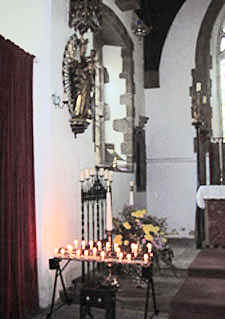
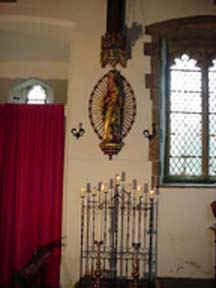
image of Our Lady crowned and with the Holy Child, was
the work of Sir Ninian Comper, and was erected
as part of a major
restoration in 1897. While the appearance of the original
shrine is
not known, the Comper image represents the type of figure that would have
stood here in medieval times.
The restoration of the church was
carried out by Comper at the
wishes of the then patron of the living, Henry, Duke of
Newcastle,
a leading Anglo Catholic layman, who lived at nearby Clumber Park. Soon,
devotion to Our Lady of Egmanton was resumed. By 1912 the Guild
of Our Lady of Egmanton, a parish society, had
been formed. Among the obligations, members
promised to say for
the parish, the Good Friday collect, one Our Father and
one Hail
Mary. Individual pilgrims began to find their way to Egmanton,
but it was not until Easter Monday 1929 that the first organized
pilgrimage in modern times took place. The parish priest at that
time was Fr Silas Harris who did much to promote the shrine.
Most
of the pilgrims came from Leicester,
but there were also groups from Leeds, Sheffield, Lincoln, and
from local parishes. An
account of the proceedings mentions the gift for the shrine of
"a fine pair of silver candlesticks in memory of the late Fr
A.H.Manning, formerly parish priest of
Egmanton".
Since that time, the number of organized and individual pilgrimages has
increased considerably. In 1930 Fr Alfred Hope Patten, restorer
of the shrine of Our Lady of Walsingham, came
with a group of his people and as a token of
their pilgrimage, left a
banner still to be seen in the shrine church. The service
registers
contain the names of many well-known
bishops and priests of the Anglo Catholic movement who came to
preach or lead
pilgrimages.. On the occasion of the Golden Jubilee pilgrimage
in
1979, the Lord Bishop of Southwell, the
Rt. Revd. John Denis
Wakeling preached at the High Mass and took part in the
afternoon
outdoor procession of Our Lady.
Today there are pilgrimages from dioceses, Forward in Faith groups and
parishes. The Society of Our Lady of Egmanton
organizes several pilgrimages each
year, details of which can be
found elsewhere on the website.
|